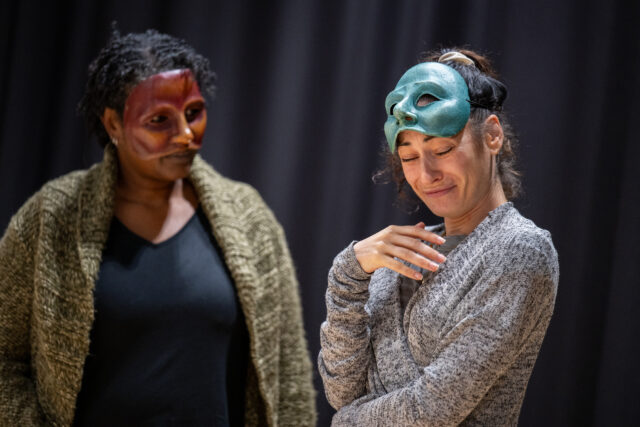
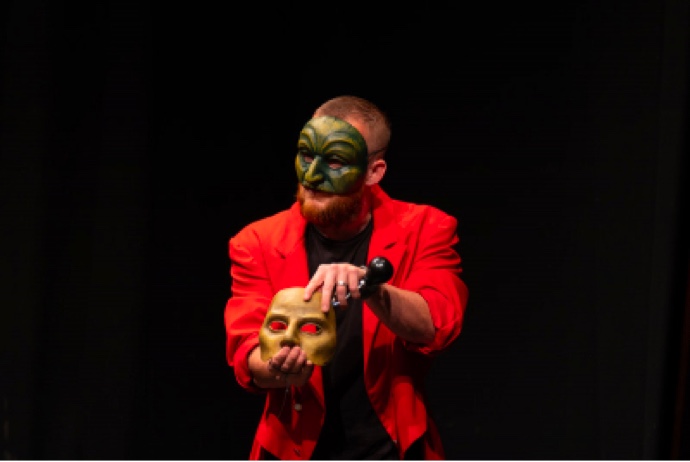
We attended an event recently exploring the role of arts in supporting communities who are traditionally underserved and who might face inequalities in relation to health, wellbeing, income, housing, education and access to opportunity. Following several presentations we raised a question about the role that arts organisations / artists play in these communities as other service providers become increasingly stretched and difficult to access. The question was really driven by some of our experiences at Geese Theatre Company in which we find ourselves often responding to needs that, historically, might have been addressed elsewhere.
The chair of the panel responded to the question by talking about the need to maintain boundaries. Of course, we agree with this but also think the situation is more complex. As statutory services become stretched, staff have ever-increasing case loads and the capacity to support reduces. As a consequence people gravitate towards the places where they feel safe, listened to and valued. This shouldn’t surprise us. Many people have already spent considerable time trying to navigate complex systems and access support without success. When someone raises a housing issue, concern about their mental health or a problem affecting their family life within the context of an arts project, it is often because they have found a place and a relationship where they feel able to do so.
Research into our own projects shows that participants often describe Geese as a place where they feel heard, where they can be themselves and where they belong. We know this isn’t unique to us – many arts organisations create spaces where people experience genuine connection, acceptance and a sense of community.
The better an arts project is at building trust and belonging, the more likely people are to want to spend time in that space. Artists are often highly skilled at creating environments that are welcoming, non-judgemental and relational. We work with the whole person, not simply the issue they have been referred with. And when people feel safe enough to bring their whole selves into a space, they also bring the realities of their lives: housing difficulties, poor mental health, poverty, trauma, loneliness, family breakdown, addiction. This is not a failure of boundaries but a reflection of the depth of trust that has been established. Relationships and connection are often central to recovery, growth and change. It is entirely understandable that people disclose difficult experiences to those they know, trust and see regularly.
Our work is about creating connection and meaning, exploring identity, developing hope and a sense of belonging. We enable people to tell their stories in their words, to rehearse future possibilities and build relationships with others. What we cannot do is provide decent housing, reduce NHS waiting lists, address poverty or replace statutory mental health services.
Our concern is that arts organisations are being asked (not explicitly) to absorb pressures generated elsewhere in the system because they remain among the few places where people experience connection, belonging and human contact.
So this becomes more than a question of boundaries – it’s a question about how arts organisations can remain true to their purpose whilst operating in communities where the need for support increasingly exceeds the capacity of the systems around them. Organisations like Geese Theatre Company need to continue to offer spaces of connection, creativity and belonging without becoming the safety net for gaps that appear elsewhere in the system.